Best Trees to Plant in Plano & Frisco, TX (And Which Ones to Avoid)
May 7, 2026
Choosing the right tree for your Plano or Frisco yard is one of the most important — and most permanent — landscaping decisions you’ll make. Plant the wrong species and you’ll spend years dealing with messy fruit, invasive roots, frequent storm damage, or disease. Plant the right one and you’ll have a beautiful, low-maintenance tree that increases your property value for decades to come.
At Quality Tree Service DFW, we remove thousands of trees every year — and a significant number of them are species that simply weren’t suited for North Texas conditions. This guide gives you an expert-informed list of the best trees for Plano and Frisco landscapes and an honest rundown of which popular species to avoid.
North Texas Growing Conditions: What Your Trees Are Up Against
Before choosing a tree species, it helps to understand what makes Plano and Frisco challenging for trees. This area sits in USDA Plant Hardiness Zone 8a, with growing conditions shaped by:
- Expansive clay soils (“black gumbo”): Extreme shrink-swell cycles stress root systems. Poor drainage in clay concentrations can suffocate roots in wet years.
- Summer heat extremes: Plano and Frisco regularly see 20–30 days above 100°F in summer. Heat stress and drought are the primary killers of landscape trees in this region.
- Unpredictable rainfall: North Texas swings between drought and flood — sometimes in the same season. Tree species need to handle both extremes.
- Ice storms: Periodic hard freezes and ice storms test structural strength and cold hardiness.
- Alkaline soil pH: Much of the Collin County soil is moderately to highly alkaline (pH 7.5–8.5), which causes chlorosis (nutrient deficiencies) in acid-loving species like pin oak.
The best trees for this region are ones that evolved here — native species that have already adapted to these conditions over thousands of years — or proven non-natives with strong regional track records.
Best Shade Trees for Plano & Frisco
🌳 Live Oak (Quercus virginiana) — Top Pick
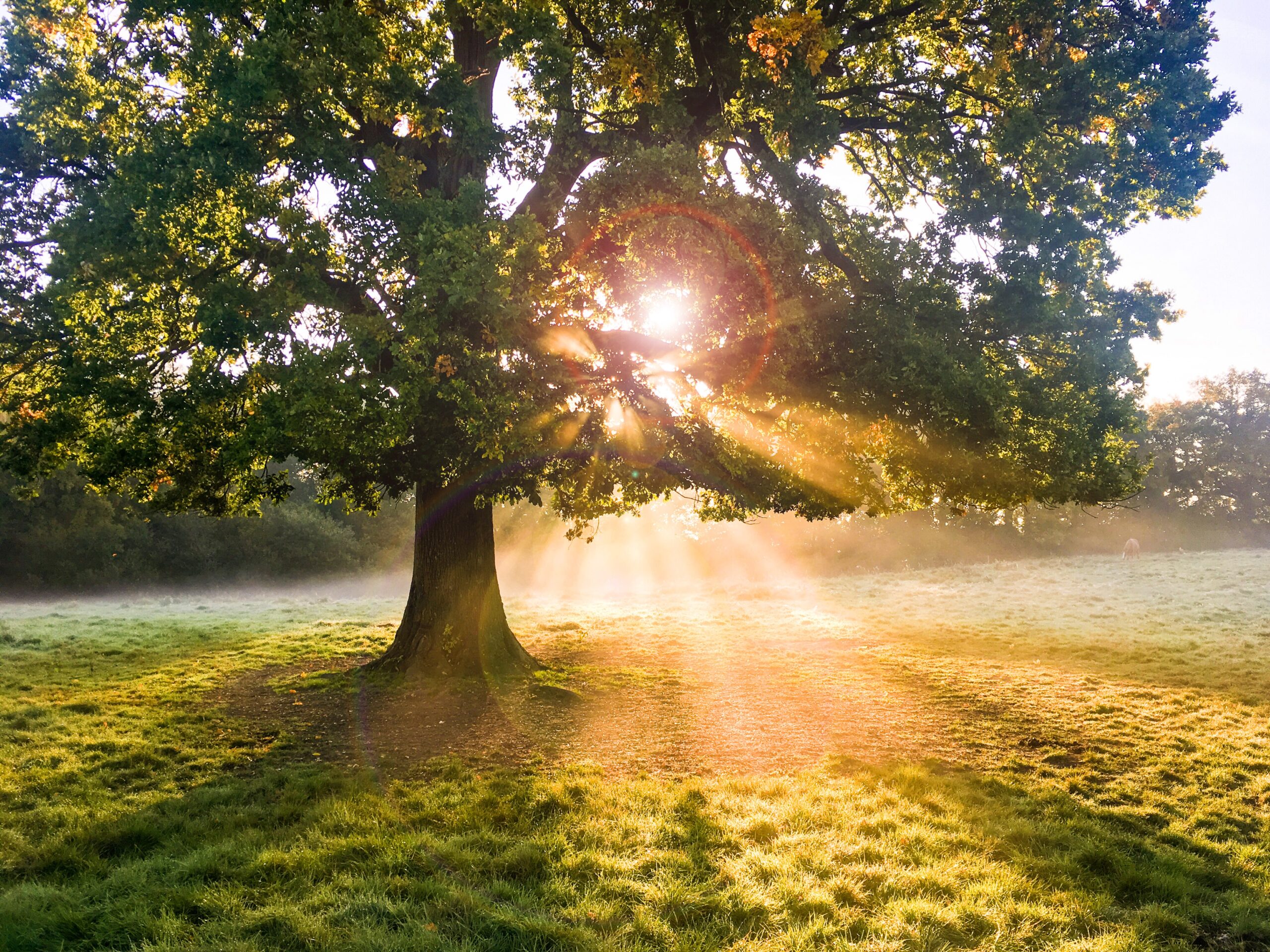
Why it’s great: The gold standard for North Texas landscapes. Live oaks are semi-evergreen (they hold their leaves through most of winter), extremely drought-tolerant once established, long-lived (100–500+ years), and provide magnificent spreading canopy. They’re also one of the most wind-resistant trees in the region thanks to their naturally low, spreading form.
Size: 40–80 ft tall, 60–100 ft wide | Growth rate: Moderate | Water needs: Low once established
⚠️ Important: Never trim live oaks between February and June due to oak wilt disease risk.
🌳 Shumard Red Oak (Quercus shumardii)
Why it’s great: One of the best large shade trees for urban North Texas lots. Shumard oaks tolerate alkaline clay soils far better than pin oaks, produce spectacular red fall color (rare in DFW), and grow faster than live oaks. A top choice for new construction lots in Plano and Frisco.
Size: 40–60 ft tall | Growth rate: Moderate-fast | Fall color: Excellent red
🌳 Cedar Elm (Ulmus crassifolia)
Why it’s great: The most drought-tolerant elm in Texas, cedar elm thrives in the alkaline clay soils of Collin County and Denton County. It’s tough, adaptable, provides good shade, and handles both wet and dry extremes well. A workhorse tree for DFW landscapes.
Size: 50–70 ft tall | Growth rate: Moderate | Water needs: Low
🌳 Bur Oak (Quercus macrocarpa)
Why it’s great: Incredibly tough and long-lived. Bur oaks have some of the thickest, most fire-resistant bark of any North American tree and are native to the DFW prairie. Slower growing than Shumard oak but essentially bulletproof once established. If you’re planting a tree to outlast your house, plant a bur oak.
Size: 60–80 ft tall | Growth rate: Slow-moderate | Lifespan: 200–400+ years
🌳 Mexican White Oak / Monterrey Oak (Quercus polymorpha)
Why it’s great: A relative newcomer to DFW landscapes that has proven itself impressively well-adapted to North Texas conditions. Semi-evergreen, fast-growing for an oak, tolerant of alkaline soils, and resistant to oak wilt. One of the best “modern” choices for Plano and Frisco yards.
Size: 40–50 ft tall | Growth rate: Moderate-fast for an oak | Water needs: Low-moderate
🌳 Pecan (Carya illinoinensis) — Texas State Tree
Why it’s great: If you have a large lot and want a majestic native shade tree, a pecan is hard to beat. Deep, stately, and productive (edible nuts). Requires deep, fertile soil and enough space — not the right choice for small suburban lots, but spectacular on larger properties in Frisco estates or McKinney acreage.
Size: 70–100 ft tall | Growth rate: Moderate | Note: Needs regular trimming to manage size and reduce storm risk
Best Ornamental & Flowering Trees for Plano & Frisco
🌸 Desert Willow (Chilopsis linearis)
A stunning native small tree with trumpet-shaped flowers in pink, purple, and white from spring through fall. Extremely drought-tolerant, deer-resistant, and virtually problem-free. Perfect for a focal point in a landscape bed.
Size: 15–25 ft | Flowers: May–September | Water: Very low
🌸 Eve’s Necklace (Sophora affinis)
A native small tree with lovely drooping clusters of fragrant pink flowers in spring and attractive seed pods. Very tough in alkaline clay, good for partial shade situations.
Size: 15–25 ft | Water: Low
🌸 Mexican Plum (Prunus mexicana)
One of the earliest bloomers in North Texas — fragrant white flowers appear in February before the leaves, providing valuable early pollinator support. Native, tough, and beautiful in a naturalistic landscape.
Size: 15–25 ft | Bloom: February–March
🌸 Texas Redbud (Cercis canadensis var. texensis)
The Texas redbud is a superior choice over the common eastern redbud for DFW, with better heat and drought tolerance. Stunning magenta-pink spring blooms, attractive heart-shaped leaves, and an appealing multi-trunk form. Excellent patio or understory tree.
Size: 15–30 ft | Water: Low-moderate | Note: Choose Texas redbud specifically, not Oklahoma or eastern varieties
Best Drought-Tolerant Trees for DFW
Given the increasing frequency of drought conditions in North Texas, drought tolerance is a priority for any new planting. These species handle prolonged dry periods especially well:
- Texas Live Oak — once established, survives extended drought with minimal irrigation
- Chinkapin Oak (Quercus muehlenbergii) — outstanding drought tolerance, great for rocky or alkaline sites
- Desert Willow — thrives in dry conditions, dies in heavy clay with poor drainage
- Anacua (Ehretia anacua) — semi-evergreen, extremely tough, fragrant white flowers
- Lacebark Elm (Ulmus parvifolia) — not to be confused with Siberian elm; lacebark elm is an excellent, disease-resistant shade tree with beautiful peeling bark
The Texas A&M AgriLife Extension maintains an excellent database of tree species recommendations by Texas region and soil type — a valuable planning resource.
Trees to Avoid Planting in Plano & Frisco
These species are commonly sold at North Texas nurseries but cause significant problems for homeowners in Plano, Frisco, and the broader DFW area:
| Tree to Avoid | Why | Better Alternative |
|---|---|---|
| Bradford / Callery Pear | Invasive species; extremely weak branch structure; splits apart within 10–15 years; spreading throughout Texas wildlands | Texas Redbud, Mexican Plum |
| Silver Maple | Brittle wood fails badly in storms; invasive surface roots crack sidewalks and foundations; short-lived in DFW conditions | Cedar Elm, Shumard Red Oak |
| Pin Oak | Struggles severely in alkaline DFW soils; develops chronic iron chlorosis (yellow leaves); requires constant treatment to survive | Shumard Red Oak, Bur Oak |
| Arizona Ash | Short-lived (15–25 years), highly susceptible to disease, weak wood; was widely planted in DFW developments and most are now dying | Cedar Elm, Lacebark Elm |
| Siberian Elm | Invasive, messy, weak-wooded, and prone to disease; often confused with the desirable Lacebark Elm | Lacebark Elm (Chinese Elm) |
| Eastern Cottonwood | Extremely large and fast-growing; invasive roots damage utilities, foundations, and underground lines; messy cotton seed | Pecan (for large lots only) |
| Mimosa (Silk Tree) | Invasive species in Texas; short-lived; weedy self-seeding; susceptible to mimosa wilt disease | Desert Willow |
Many of these problem trees were planted throughout Plano and Frisco during the development booms of the 1990s and 2000s and are now reaching the end of their lifespans — which is why we remove so many of them. If you have any of these species on your property, a professional assessment can help you plan proactively rather than waiting for an emergency removal.
Planting Tips for Long-Term Success in DFW
- Best planting time: October through February. Fall planting gives trees a full cool season and spring to establish roots before summer heat arrives.
- Dig wide, not deep: In clay soils, dig a planting hole 2–3 times wider than the root ball but only as deep as the root ball. Planting too deep is one of the leading causes of tree death.
- Don’t amend the backfill: In clay soils, backfill with the native soil from the hole. Amended backfill creates a “bathtub effect” that holds water and suffocates roots.
- Mulch properly: Apply a 3–4 inch ring of organic mulch (wood chips or shredded bark) out to the drip line. Keep mulch 4 inches away from the trunk — volcano mulching kills trees.
- Water deeply but infrequently: Deep, infrequent watering encourages deep root development. Shallow, frequent watering creates surface-dependent root systems vulnerable to drought and instability.
- Hold off on fertilizer: Don’t fertilize newly planted trees for at least the first year. Focus on root establishment, not top growth.
The Arbor Day Foundation’s planting guide provides excellent step-by-step instructions that apply well to North Texas conditions.
Professional Tree Care After Planting
Even the best tree choice needs proper ongoing care to thrive. Quality Tree Service DFW provides the full range of tree care services throughout the Plano, Frisco, and DFW area:
- Tree trimming and structural pruning — formative pruning in the first 5 years sets young trees up for strong, storm-resistant structure
- Tree removal — when a problem tree needs to come out before you plant a better one
- Stump grinding — clear the old stump so your new tree has a clean site
Ready to Remove a Problem Tree and Start Fresh?
If you have a Bradford pear, silver maple, Arizona ash, or other struggling species that needs to come out before you plant something better, Quality Tree Service DFW provides professional removal throughout Plano, Frisco, and all of DFW. We’ll also grind the stump so your new planting site is completely clear.
- 📍 Serving Plano, Frisco, McKinney, Dallas, Lewisville, Flower Mound & all DFW
- 📞 (214) 407-2385 — Call or text anytime
- ✅ Free estimates | Licensed, insured & bonded
👉 Get My Free Tree Removal Estimate